
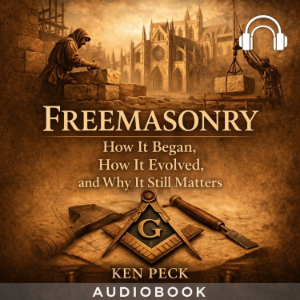
Freemasonry: How It Began, How It Evolved, and Why It Still Matters
Ken Peck
This audiobook is narrated by a digital voice.
In Freemasonry: How It Began, How It Evolved, and Why It Still Matters, Ken Peck offers a clear and thoughtful examination of the Craft from its earliest origins to its place in the modern world. This is...
Location:
United States
Description:
This audiobook is narrated by a digital voice. In Freemasonry: How It Began, How It Evolved, and Why It Still Matters, Ken Peck offers a clear and thoughtful examination of the Craft from its earliest origins to its place in the modern world. This is not a book of secrets, nor is it an attempt to persuade. Instead, it is an effort to explain—plainly and directly—what Freemasonry is, where it came from, and why it continues to endure. Beginning with the operative stonemasons of the medieval period, the book traces the transition from a working trade to a speculative fraternity. It explores how the tools and practices of builders became symbols for personal development, and how those symbols have been preserved and adapted across centuries. Along the way, it addresses the historical forces that shaped Freemasonry, including periods of growth, suspicion, and opposition. But history alone does not explain Freemasonry’s persistence. This book also examines the internal structure of the lodge, the role of ritual and symbolism, and the expectations placed upon its members. It considers what the fraternity asks of a man, and what a man may gain from participation—not in material terms, but in discipline, accountability, and personal character. Equally important, the book confronts the many misconceptions that surround Freemasonry. It distinguishes between privacy and secrecy, between influence and conspiracy, and between public perception and lived experience. In doing so, it provides a balanced perspective for both Masons and non-Masons alike. Freemasonry does not promise wealth, status, or advantage. What it offers instead is more demanding: a framework for self-examination, a commitment to improvement, and a Brotherhood built on shared principles. These are not modern inventions, nor are they easily dismissed as outdated. They are the very reasons Freemasonry has endured. Duration - 2h 30m. Author - Ken Peck. Narrator - Digital Voice Marcus G. Published Date - Thursday, 01 January 2026. Copyright - © 2026 Ken Peck ©.
Language:
English
Introduction — A Tradition Worth Understanding
Duration:00:04:18
Part I - Origins: How Freemasonry Began
Duration:00:00:04
Chapter 1 — The Working Mason
Duration:00:06:07
Chapter 2 — From Craft to Character
Duration:00:05:02
Chapter 3 — The Lodge Before Speculation
Duration:00:05:33
Chapter 4 — The Transition to Speculative Masonry
Duration:00:05:35
Chapter 5 — The Influence of the Enlightenment
Duration:00:05:47
Chapter 6 — The Formation of Grand Lodges
Duration:00:05:19
Chapter 7 — Early Ritual and Symbol
Duration:00:06:03
Chapter 8 — Freemasonry in the New World
Duration:00:05:34
Part II - Evolution: How Freemasonry Developed
Duration:00:00:05
Chapter 9 — Growth and Expansion
Duration:00:05:35
Chapter 10 — Freemasonry on the American Frontier
Duration:00:05:44
Chapter 11 — Brotherhood in Times of Conflict
Duration:00:05:57
Chapter 12 — Public Perception and Suspicion
Duration:00:05:44
Chapter 13 — Reform, Decline, and Renewal
Duration:00:05:25
Chapter 14 — The Structure of Modern Freemasonry
Duration:00:05:52
Chapter 15 — The Role of Ritual in a Changing World
Duration:00:05:37
Chapter 16 — Freemasonry and Community
Duration:00:05:45
Part III — Meaning: Why Freemasonry Still Matters
Duration:00:00:04
Chapter 17 — The Purpose of the Craft
Duration:00:05:42
Chapter 18 — Building Character in a Changing World
Duration:00:05:50
Chapter 19 — Brotherhood Beyond Association
Duration:00:06:28
Chapter 20 — A Moral Framework Without Dogma
Duration:00:06:27
Chapter 21 — The Value of Symbol and Reflection
Duration:00:06:24
Chapter 22 — The Individual Journey
Duration:00:06:12
Chapter 23 — Misconceptions and Reality
Duration:00:06:47
Chapter 24 — Why It Endures
Duration:00:05:59
Conclusion — Not For Everyone (And That’s the Point)
Duration:00:03:42
About The Author
Duration:00:01:30