
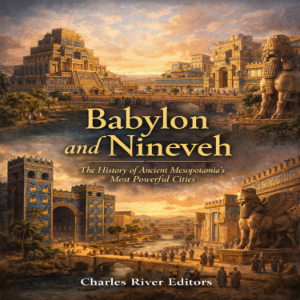
Babylon and Nineveh: The History of Ancient Mesopotamia’s Most Powerful Cities
Charles River Editors
Today, Babylon has become a byword for greed, excess, and licentiousness, mostly due to its mention in the Bible, but a closer examination reveals that Babylon was so much more, and even perhaps the most important city in the ancient world. Ancient...
Location:
United States
Description:
Today, Babylon has become a byword for greed, excess, and licentiousness, mostly due to its mention in the Bible, but a closer examination reveals that Babylon was so much more, and even perhaps the most important city in the ancient world. Ancient Babylon was home to great dynasties that produced some of the world’s most influential leaders, most notably Hammurabi and Nebuchadnezzar, and these rulers invoked their wills on the entire ancient Near East and have been remembered as both progressive and cruel all at the same time. Babylon was also the seat of culture in ancient Mesopotamia and the place where scholars made amazing scientific advances that would not be eclipsed for several centuries. An examination of ancient Babylon demonstrates that it was truly the first great city in the ancient world. Of course, the sheer span of history between Babylon’s power and today has produced plenty of historical questions and controversy. One of the things people most closely associate Babylon with is the Hanging Gardens, which, like the Great Pyramid of Giza, were considered both a technological marvel and an aesthetic masterpiece. Babylon was also instrumental in the development of the region’s religions, which continue to captivate people. When Nineveh was at its height, the rulers of the city controlled an empire that encompassed Egypt, Anatolia, Mesopotamia, and parts of Iran. Eventually, the Assyrians overextended themselves and their enemies overthrew them and destroyed much of their cities. Nineveh became lost for centuries, only mentioned in fragments by classical Greek historians, but modern archaeological methods were able to bring the lost city back to life in the nineteenth century. Today, through a combination of archaeological reports, classical Greek accounts, and ancient cuneiform inscriptions, the chronology of Nineveh can be reconstructed. Duration - 3h 26m. Author - Charles River Editors. Narrator - Victoria Woodson. Published Date - Wednesday, 28 January 2026. Copyright - © 2026 Charles River Editors ©.
Language:
English
Opening Credits
Duration:00:00:10
Introduction
Duration:00:07:30
The Babylonians
Duration:01:31:43
Nineveh at Its Peak
Duration:01:05:06
Ashurbanipal and Nineveh
Duration:00:19:04
The Fall of Nineveh
Duration:00:22:45
Ending Credits
Duration:00:00:10