
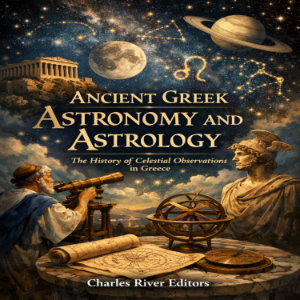
Ancient Greek Astronomy and Astrology: The History of Celestial Observations in Greece
Charles River Editors
For the ancient Greeks, the gods were capricious beings subject to the same passions, emotions, and vicissitudes as humans were, and no more enlightened as to the nature of existence and the path to a good and happy life. Given the fallibility of the...
Location:
United States
Description:
For the ancient Greeks, the gods were capricious beings subject to the same passions, emotions, and vicissitudes as humans were, and no more enlightened as to the nature of existence and the path to a good and happy life. Given the fallibility of the gods in Greek mythology, some philosophers and scientists stepped in where religion refused to go. As early as the 6th century BCE Greek thinkers began to thoroughly explore the world and the actions of humans through natural science, reason, mathematics, metaphysics, and ontology. After Thales, a stream of philosophers, mathematicians, and engineers emerged, including names that are well known today, including Plato, Aristotle, Socrates, Pythagoras, Archimedes, Heraclitus, Epicurus, and Diogenes. For the ancient Babylonians and Egyptians, sky watching served religious or practical purposes, but for the Greeks, it was also theoretical. They wanted to know why heavenly bodies moved as they did, and for that reason, the Greeks added mathematics, geometry, and philosophical reasoning to the crucial foundational data of the Sumerians, Babylonians, and Egyptians. Over hundreds of years, various Greek innovators explored the underlying mechanics of the universe, leading to the first physical models of the cosmos. By the 5th century BCE, Pythagoras proposed that the world was not flat, but a sphere, Anaxagoras explained why eclipses happened and described meteorites, and Leucippus and Democritus wrote that tiny, invisible atoms were the building blocks of the entire universe. By the 3rd century BCE, Aristarchus of Samos taught that Earth rotated on its axis each day and revolved around the Sun each year. Eratosthenes used geometry to calculate the distance around Earth from pole to pole, and he came unbelievably close to precisely accurate measurements. Thanks to these scientific pioneers and their works, the Greeks laid the cornerstone of modern astronomy. Duration - 2h. Author - Charles River Editors. Narrator - Steve Knupp. Published Date - Monday, 19 January 2026. Copyright - © 2026 Charles River Editors ©.
Language:
English
Opening Credits
Duration:00:00:10
Introduction
Duration:00:06:59
The Tokugawa Shogunate
Duration:00:10:20
The Opening of Japan
Duration:00:21:12
Emperor Meiji
Duration:00:07:13
The Great Saigo
Duration:00:07:05
The Start of the Satsuma Rebellion
Duration:00:27:32
The Samurai's Last Stand
Duration:00:16:59
The Restoration Continues
Duration:00:22:38
Ending Credits
Duration:00:00:17