
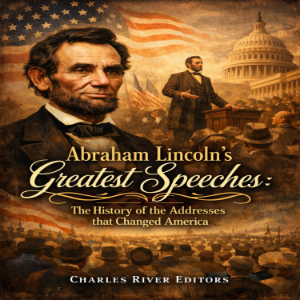
Abraham Lincoln’s Greatest Speeches: The History of the Addresses that Changed America
Charles River Editors
Abraham Lincoln was still not considered a real option for the Republican presidential nomination until he delivered a speech at New York City’s Cooper Union in February 1860, just a few months before the Republicans’ convention in May. Lincoln had...
Location:
United States
Description:
Abraham Lincoln was still not considered a real option for the Republican presidential nomination until he delivered a speech at New York City’s Cooper Union in February 1860, just a few months before the Republicans’ convention in May. Lincoln had gained a bit of a national profile by debating Stephen Douglas during an Illinois Senate Race in 1858, and though he lost that election, Lincoln continued discussing the same themes, most notably slavery and Dred Scott in his Cooper Union speech. Although just 7,000 words long, the Cooper Union Address was almost universally praised in the North. Over 160 years later, Lincoln's Gettysburg Address is still considered arguably the greatest speech in American history. The address only took a few minutes, but in those few minutes, Lincoln invoked the principles of human equality espoused by the Declaration of Independence. In the process, he redefined the Civil War as a struggle not merely for the Union but as "a new birth of freedom" that would bring true equality to all of its citizens, ensure that democracy would remain a viable form of government, and would also create a unified nation in which states' rights were no longer dominant. Lincoln wasn’t given a chance to finish his work, but his thoughts and visions were eloquently saved for posterity in his Second Inaugural Address, delivered a month before his death and considered one of America’s greatest speeches. With the war nearing the end, Lincoln struck a conciliatory tone, reminding both sides that they prayed to the same God for victory and that neither side could divine God’s will. “With malice toward none, with charity for all,” Lincoln called for peace and reunion, his eye clearly on Reconstruction. Nobody will ever know how Lincoln would’ve managed Reconstruction, but in many respects, the Second Inaugural Address was a fitting postscript of sorts to his life and legacy. Duration - 4h 57m. Author - Charles River Editors. Narrator - Bill Caufield. Published Date - Sunday, 11 January 2026. Copyright - © 2020 Charles River Editors ©.
Language:
English
Opening Credits
Duration:00:00:09
Introduction
Duration:00:11:28
19th Century Politics
Duration:00:31:39
A Political Speech
Duration:00:42:00
The Inalienable Rights of Men
Duration:00:21:42
The Aftermath of the Cooper Union Address
Duration:00:14:57
The Battle of Gettysburg
Duration:00:22:39
Planning a Dedication
Duration:00:07:37
Writing the Speech
Duration:00:08:54
The Gettysburg Address
Duration:00:29:26
The Climax of American Eloquence
Duration:00:16:10
Reaching the End of the War
Duration:00:22:10
Lincoln's Second Inaugural Address
Duration:00:35:25
A New Era
Duration:00:33:00
Ending Credits
Duration:00:00:09